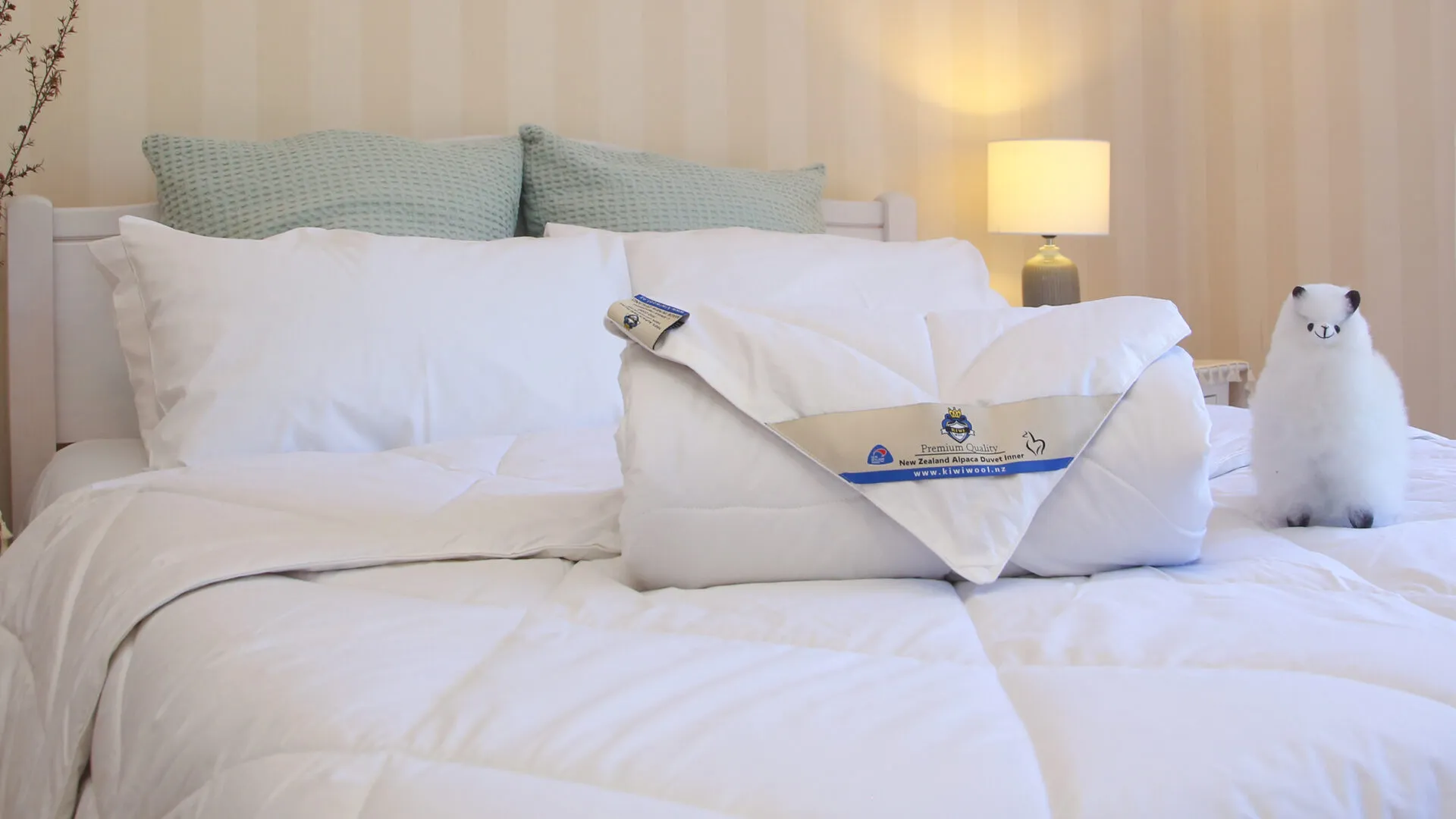
Is the cover moving, or is the filling moving?
Lay the uncovered inner flat. If its sewn shape is intact and the filling looks reasonably even, but it gathers inside your removable cover, start with fit and fastening. If the uncovered inner itself has unusual thin patches or a new lump that stays in place, the issue may be within the casing.
These are different problems. A smaller cover will not repair displaced filling. Photograph any persistent change in the inner before trying a fix, and discuss it with Kiwi Wool if you are unsure.
Check measurements before changing anything
Read the size label on the inner and on the cover. Measure both flat if either label is missing or the cover has changed after laundering. Bed-size names are a starting point, but the actual dimensions are what must work together.
Check width and length, particularly on a rectangular inner. A duvet turned sideways can leave excess fabric in one direction and feel crowded in the other. Use our NZ duvet size guide for the wider sizing discussion, and confirm the finished dimensions of your chosen product before ordering.
Refit it in five steps
- Lay everything out. Turn the cover inside out on the bed, with its opening accessible. Lay the inner flat in the matching orientation.
- Match all four corners. Make sure the inner reaches the cover’s corners without stretching either item. Excess fabric is a clue to recheck size.
- Inspect existing fastenings. If your actual inner and cover have compatible ties or loops, use them as intended. Do not assume every Kiwi Wool model or older version has the same fittings.
- Turn the cover over the inner. Keep the paired corners together. Ease the fabric into place rather than yanking the casing or fastenings.
- Close and smooth. Close the cover opening, smooth the edges and check that the filling is spread across the bed. Recheck after normal use.
Use the result to decide what to do next
| Result | Next step |
|---|---|
| Large empty border inside the cover | Compare measured dimensions. Choose a closer match when replacing the cover. |
| Corners match but the inner moves | Check existing compatible fastenings and whether the cover closes properly. |
| One edge is crowded, another is empty | Check width-versus-length orientation. |
| Persistent lump in the uncovered inner | Photograph it and ask Kiwi Wool for advice. |
| Loose thread or damaged seam | Pause adjustments and contact the maker before modifying it. |
Keep the fix reversible
Do not cut or stitch through the casing as a first attempt to add ties. Avoid sharp pins and improvised fasteners that could damage the fabric. Ask the maker about a suitable option if the cover and inner do not have compatible attachment points.
Washing the duvet to shrink it into a different shape is not a fit solution. The current Kiwi Wool wool and alpaca inners have dry-clean-only instructions. Wash the removable cover only according to its own label.
If the fit still looks wrong, send the inner and cover dimensions, product name and a photo of them laid out together. That is a more useful enquiry than “my duvet bunches up” alone and may save replacing an otherwise suitable inner.
A few useful answers
Should the cover be much larger than the inner?
A large mismatch gives the inner room to move. Compare actual finished dimensions and ask about compatibility rather than selecting by a size name alone.
Do all Kiwi Wool inners have corner ties?
Check your own inner for corner ties or loops. If you want ties on a new inner, ask Kiwi Wool which models have them before ordering.
Can I make the inner thicker to fill the cover?
Do not open a quilted duvet casing or add filling. Its construction differs from the adjustable alpaca pillow. Check fit or ask for product support.